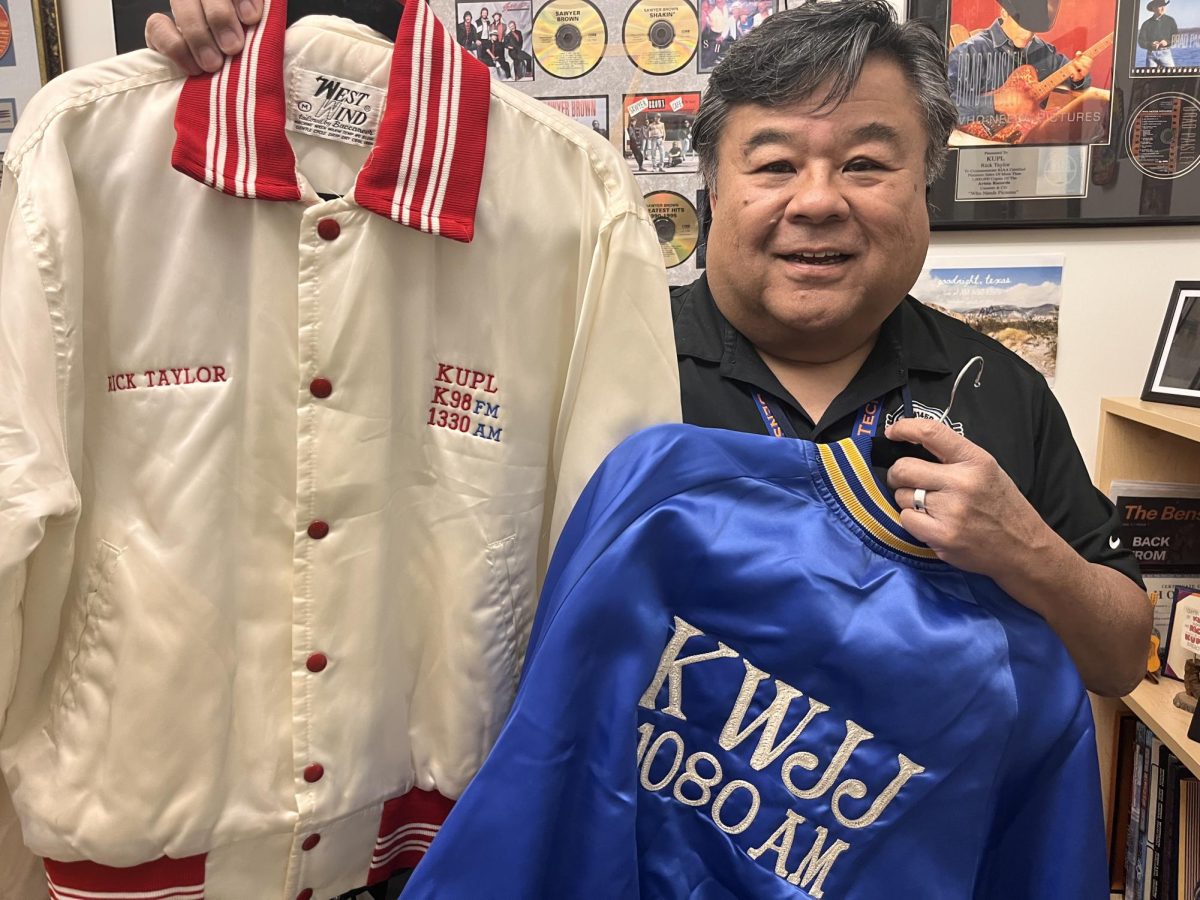
“Embracing my identity as a Japanese American, I’ve always been proud within, I just didn’t feel like I could be proud outside,” said Rick Kinoshita, an alumnus of Benson Polytechnic High School from the 1970s who helped to start the school’s radio major. After beginning his radio career at KBPS, he faced severe discrimination as a Japanese American throughout his entire career in the industry. On the radio, he was forced to go by Rick Taylor, a white-sounding name, because his Japanese name would supposedly lower his ratings. Despite this, he had a successful career and, after retiring, returned to KBPS as the operations manager, which has helped him learn to embrace his identity as a Japanese American.
Starting school at Benson in 1974, Kinoshita dreamed of playing basketball, but after being rejected from the team, a cousin encouraged him to try the school’s radio station. He instantly fell in love. “I found that, here’s something [where] people accepted me,” he recalled. “I could pretend to be anything I want […] so I hid behind the microphone, [and] became very successful beyond the microphone.”
At the time, radio was still only a club at Benson. Kinoshita wanted to major in it, and petitioned the school board to make radio a full major. “I was the second person to ever major in broadcasting at Benson,” he said.
While still a student at Benson and early in his career, Kinoshita landed a job at a Top 40 radio station in Portland, but they didn’t let him use his real name. “So they gave me the name ‘Rick Shaw,’ because the program director thought that was funny, like [a] rickshaw, like a Chinese race show.” Kinoshita asked to use his real name instead, but was denied. “He stuck his buck teeth out, and slanted his eyes, and said, ‘Like, rickshaw, you get it, rickshaw.’” Kinoshita tried to advocate for himself, but was instead met with racist “jokes” at the age of 17. He felt he couldn’t do anything else. “I didn’t create any friction because that would have caused me not to get any opportunities, so I just went with it and just stayed silent.”

Slightly later in his career, at a different station, Kinoshita again wanted to use his real name, but was given a different one. Despite the attack on Pearl Harbor happening 40 years prior, Kinoshita was told he couldn’t go by his Japanese name because people would associate his name with it, and lead to lower ratings. “So they gave me a Caucasian name,” Rick Taylor. “I was just excited to be on a radio station.” Later, Kinoshita added “Bubba” to his on-air name because it was a nickname given to him by a co-worker.
Kinoshita spent the beginning part of his career at a country station, which wasn’t a diverse genre at the time. This meant that fans were typically more conservative than those that listened to other genres. Going by a white name on the radio was meant to convince listeners that Kinoshita was white, so when listeners met him face to face, their expectations were completely different.
He remembered being at a store in Washington Square Mall, “and the manager said, ‘Yes, that is Rick Taylor, Rick Bubba Taylor,’ you know?” A man then expressed surprise at his appearance, and incorrectly assumed he was Chinese, while using a racial slur for a Chinese person. “I was shocked because there’s people around. It’s embarrassing. So I tried to diffuse it by handing him a keychain.” The man, Kinoshita said, knocked the keychain out of his hand and called him an anti-Asian racial slur.
After this experience, Kinoshita felt that he truly needed to pretend he was white, and at the time realized “there’s really a lot of hate out there” in country music. “It’s not that bad now, country is very diverse now, but back then it was […] very white bread, milquetoast, kind of people.” Kinoshita noted that fans “didn’t want to see anybody of any color.”
When Kinoshita retired from the radio industry, he was given a different view of his identity. “I don’t have to please people for ratings. If you’d like me, I thought you’re gonna like me because I’m who I am. So I just really felt like something was lifted off of me.”
He later returned to Benson as the KBPS operations manager. “They reached out to me and said, ‘Hey do you want to come back here?’ And I thought, well, absolutely, this is where I started my career.” Kinoshita now makes sure the radio station runs smoothly and occasionally works with students.
He added, “That was really helpful in helping me […] be who I am, because outside my door there is my name. It’s my real name.” Kinoshita explains that being at Benson again has helped him embrace his identity, “That’s who I was when I first walked into this radio station in 1974 and that’s who I am today in 2026 […] Coming back to Benson and being able to be myself, that [helped] me come out and be proud of who I am, and not be ashamed of it.”
Kinoshita believes everyone needs to spread awareness about experiences like his. “The more that we talk about this, the more that we can not approach it with anger and division, I think it’s going to help people.” Kinoshita feels strongly against bringing more hate into the world. “You know, I want to be the change that I want to see in the world. I don’t want to hate someone because they hate me, because then you’re controlling me. And I don’t want anyone to control me, I wanna control myself.”
Throughout his career, he dealt with ignorance and racism, but he persisted. Kinoshita believes that a variety of cultures should be embraced. “I think it’s interesting, you know, that there’s so many people that look different, they speak different languages, they have different cultures […] I think that’s what makes the world beautiful.”
Kinoshita aims to tell other individuals that have faced discrimination and struggle with their identity to, “Know who you are, be proud of who you are, and don’t worry about what other people think of you. I know that it hurts and our feelings, we want to be accepted. But the most important thing is within, and be proud of who you are, embrace yourself, embrace others. And I think going through what I’ve gone through with racism has helped me actually in many ways, because it’s helped me accept other people for who they are.”
Kinoshita emphasized, “Embrace your differences, and just try and embrace others in the same way. Because if you hold all that pain and hurt in, it’s just going to make you want to retaliate towards other people, and that just instills more hate and division. The only way you can be free of that is not to let them affect you and the way that you feel about things.”